Slowly slapped with garlic

Wandered down a very quiet side street in Sorrento and stumbled upon an amazing restaurant today; the Inn Bufalito. [My wife had seen a reference to it in one of the guide books, so we weren’t taken completely by surprise.] Incidentally, there has always been a joy in stumbling across things in the physical universe; the pleasure was not created by, nor is the sole property of, the digital world.

DSC_0001.JPG

The sign says “Italian Slow Food and Drink” and you’d better believe it. There’s nothing hurried about this place, it’s more poco piu largamente than it is adagio. Which is a good thing. Because the food there is absolutely brilliant, and does not deserve to be rushed.

We decided to have our lunch there. Here’s what was on offer as the “specials” of the day, the blackboard dishes:

DSC_0002.JPG

Given my predilection for different types of pasta with different types of ragu sauce, I succumbed and had a red meat dish for the first time in a fortnight, if you don’t count the odd slice of prosciutto. So I went for the paccheri al ragu di bufalo. And this is what I got:

DSC_0006.JPG

Superb. Paccheri pasta, the big broad firehose-section tubes of pasta you see above, served with a very very slow-cooked buffalo fillet ragu. When I say slow I mean slow. Cooked overnight. Bufalo (fillets of buffalo), piccolo pomodoro (small sweetish local tomatoes), cipolle (small fresh onions), lots of garlic, celery stalks, carrots, salt, pepper, olive oil, white wine. Cooked for at least 12 hours.

The meal also solved a long-standing problem for me, the reason why the pasta was called paccheri. I had originally been told it had something to do with smuggling garlic centuries ago, as suggested here. Which appeared to be true. But then I’d heard that paccheri actually meant “slaps” in Neapolitan, as suggested here, and which appeared to have nothing to do with the garlic story.

The chef at the inn solved it. The answer’s both. The word means “slaps”, apparently to do with the sound the pasta makes when you try and manhandle it with a fork and knife. So that answer is right. On the other hand, paccheri was invented in order to smuggle garlic; the expensive cloves were hidden inside the tubes, and the tubes were then transported across city-state borders in order to break up some monopolies and trade barriers. So one has to do with the origin of the word, while the other had to do with the reason for its invention.

By the way, the rest of the food there wasn’t bad either. Here’s my son’s gnocchi and my daughter’s lasagne:

DSC_0004.JPG

DSC_0005.JPG

Cheap. Unhurried. Quiet. Good-sized meals lovingly prepared. And a fabulous taste. So if you ever happen to come by the Sorrento area, do pay a visit to the Inn Bufalito.

Thinking about Mario, Pompeii and the internet

I spent some time with the family wandering around Pompeii at the weekend. It was a wonderful experience; while I’d been there before, it was a long time ago: the technology of archaeology has moved forward apace; and I was twenty-five years older. [We’d gone to Sorrento for our honeymoon in 1984. We decided it would be fitting to go back there for our silver anniversary, this time with the children.]

There were many things I learnt, much that was brought to mind. Some of you probably think I read too much Jane Jacobs (and for that matter, Christopher Alexander) for my own good. So be it. I’d happily re-read The Death and Life of Great American Cities every six months or so; if you haven’t discovered Jane Jacobs stop reading now, go to the book-buying web site of your choice and order pretty much anything by her. Alexander’s A Pattern Language is probably somewhat less accessible, but still definitely worth a read.

So what did I learn?

I learnt that the buildings in Pompeii that had arched and domed rooms and gateways fared much better than the rest.

DSC_0080.JPG

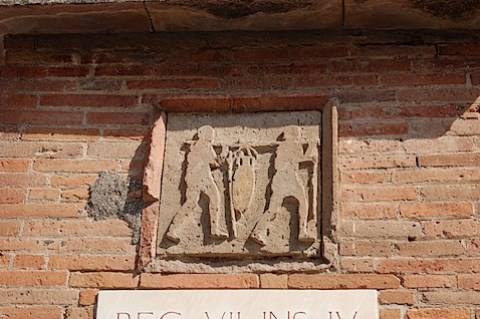
I learnt that Pompeii was a cosmopolitan place where they’d worked out the importance of using culture-crossing graphics and symbols rather than words.

DSC_0121.JPG

DSC_0173.JPG

I learnt that they had interesting models of re-use: for example, they used the fragments of ceramics smashed in the earthquake of 62AD to form and decorate floors:

DSC_0152.JPG

I learnt that they took real care in their design, making the roads work as rainwater escapes as well: the city was built on igneous rock which was less than perfect as a flood plain. But then it would be hard for people to cross the streets, so they embedded the streets with crossing stones at regular intervals:

DSC_0089.JPG

DSC_0084.JPG

I learnt that they used natural materials as cat’s eyes, embedding pavements and floors with reflective stones as shown below:

DSC_0087.JPG

DSC_0169.JPG

I learnt that they cared about waste and recycling, saw what they built under the rooms (and for that matter how they reused urine as fertiliser).

DSC_0158.JPG

I learnt that they had open standards and component architecture. For example, they had 38 different sizes of container for food and drink, and everyone used the same sizes to mean the same things:

DSC_0143.JPG

I learnt that they did all this with time for beauty and enjoyment in their architecture and layout:

DSC_0151.JPG

I learnt that they did all this under the shadow of Vesuvius, a fragile and beautiful peace in the presence of danger:

DSC_0179.JPG

But you know what? I could have learnt all of this from a book. I could have learnt all this from the internet.

Which brings me to the point of this post.

Mario. 65 years old this year. Been doing the job of personal tour guide for 48 years. A wonderful, passionate man, passionate about everything he does, passionate about Pompeii, its history and culture, passionate about archaeology, passionate about learning. Someone who has seen the impact of bad decisions from an archaeological perspective, someone who cares enough to celebrate the learning that comes from those decisions.

DSC_0072.JPG

All this time I was seeing things in Pompeii, and thinking about the internet.

But Mario changed all that. He saw things in the internet and started thinking of Pompeii.

You see, Mario’s stopping work for a year or two. He’s not retiring, even though he’s 65. He’s going back to school.

Why? Because of the internet. He realises that the internet (particularly the web) reduces the barrier to entry for information and knowledge; that it exposes paucity of knowledge, and raises the bar for standards in professions where knowledge is a form of expertise.

He has seen his colleagues and peers, so-called experts, fail to hold the attention of crowds, as they bleat on about things we can all find out from the web. He is too passionate about his profession, his skills, his way of life to allow the internet to weaken him. He is too passionate about Pompeii, about its history, about his history, to roll over and give up.

So Mario, aged 65, a consummate professional, a passionate expert at what he does, is going back to school.

Because of the internet.

And you know what? He’s looking forward to it.

So I will be back in a few years’ time, to see Mario. To see what he has learnt. And how he keeps ahead of the internet.

In manufacturing we speak of a “China Price”. Maybe Mario’s tale suggests that for knowledge we should start speaking of an “internet price”.

In the meantime, here’s to Mario, and to all the Marios of this world. Passionate about what they do, choosing to embrace and extend the internet.

Crowdplaying: Of Three Wolf Moons, Caroline of Brunswick (and Complete and Perfect Tutnums)

The internet’s been an interesting place this week. Particularly for crowdplaying. Crowdsourced humour.

First off we had the almost-rained-off first day’s play at Edgbaston for the Third Ashes Test. [Now for people who don’t know anything about cricket, that’s a biennial cricket match between England and Australia]. Play was scheduled to begin at 11am; it rained all day; play did begin at around 5pm. But in the meantime:

QueenCaroline1820

The Caroline of Brunswick article in Wikipedia took a mighty hammering, despite stout defence from William Avery, who did everything possible to justify his Senior Editor with Platinum Editor Star status. [Incidentally, I now have a new ambition. To become a Complete and Perfect Tutnum of the Encyclopaedia. It was a joyous morning without a ball being bowled, with edits blazing from end to end, so much so that Caroline of Brunswick was rumoured to have become the 5th most searched item on Google that afternoon.

Not quite the place to look for humour. But hey, this is the internet, where anything’s possible. Laughter in the TMS inbox I could believe, but in an article on Caroline of Brunswick?

Then, today, thanks to Chris Brogan, I found an unlikely streak of humour in an even more unlikely place: The Mountain Men’s Three Wolf Moon Short Tee Shirt.

51jZitVcKmL._SS500_

No, it’s not on the t-shirt. Just take a look at the reviews of the item on Amazon. 136 customer reviews. 13,171 finding the first review helpful. 181 comments on that review. Don’t stop there, you must take a look at some of the other reviews. Preferably while sitting down in a comfortable position.

Culture comes in many shapes and forms; the internet is a land of wondrous promise as people find old and new ways to do old and new things. If we let them.