In two words, Im-possible: The problem with counterintuition

Nearly 40 years ago, we were asked this question at school:

Imagine a string tied around the middle of an orange, in effect forming a circumference. Now imagine another string, this time tied around the middle of the earth, at the equator.Okay? Now increase the length of each of these strings by a foot. Imagine each string now suspended around its sphere as an annulus. Tell me, which string will be further away from the sphere it contains?

And we all answered “the one around the orange, of course”. Or words to that effect. And we wondered why someone would ask such a silly question.

And then we did the math.

  • C=2pi r
  • C+1=2pi R
  • R-r=(C+1)/2pi -C/2pi
  • Or (cancelling out the Cs), R-r=1/2pi

What?!?! How can this be? How can the change in radius be independent of the circumference of the sphere (or for that matter the radius)? You mean that both strings will be the same distance away from “their” sphere? Im-possible.

It didn’t matter how many times we invoked Sam Goldwyn (he was still alive at the time), the answer did not change. No hidden tricks. No small print. No scams involving oranges and geoids. Just the facts. When you increase circumference by X, the radius increases by X/2pi. Regardless of what the original radius was. Regardless of what the original sphere was. One string round a table tennis ball, the other round the sun, same answer.

I tell you, it kept me up nights as a boy, it just didn’t make any sense to me. I had to drill the answer into my head, drag it there kicking and screaming. It took time, but the pain subsided in the end.

And then.

And then I bought two fascinating books by Julian Havil: Nonplussed and Impossible. Books that were tailormade to fit in to that odd space in my library, between Martin Gardner and John Allen Paulos.

And went through all that pain again. From “does not compute” to “im-possible” to “I don’t believe it”. So if you’ve got a similar penchant for mind-masochism, go out and buy the books. Both of them. You won’t regret it.

I need to keep challenging my biases and prejudices, the anchors and frames I cannot see. And books like these help me exercise my mind, they ensure that I don’t reject ideas just because they’re counterintuitive.

Musing about design and convenience

I’ve just got to Shanghai for the first time, and despite working through what passed for night in China and in the UK, I found myself bright-eyed, bushy-tailed and full of beans. Having been ensconced in design strategy papers for a good few days, I think I’m looking at everything through “design” eyes, and trying to make sure I’m not jaundiced in any way.

The first thing that made me feel good was the socket (or what I used to call a “plug-point” in India). At the hotel here, they have sockets that look like this:

Wikipedia (which is where I got that illustration, by the way) tells me that this is a Type G (British 3 Pin) plug and socket, conforming to BS 1363. Which means I didn’t need an adaptor for once, a nice feeling. Strange, that I have to come all the way to China to get that feeling. Incidentally, just take a look at this map, available from Wikimedia Commons:

What the map does is set out the plug type in use in a given region, and it’s interesting to see some sort of colonial history laid out in the process. We’d probably get something similar if we looked at rail gauges, I guess, and I can’t help worrying that there’s an internet variant just waiting for us, a 21st century map of standards and protocols that reflect colonies of lock-in.

Enough worrying. There are so many things in this hotel room that make me feel good, that make me realise that someone’s applied thought to the design of the room, that someone’s actually considered what the customer may want.

There’s the ethernet point just where you would look for one, built subtly into the desk and covered with a little removable leather pad; there’s the cups and saucers and tea bags loudly signalling the existence of a kettle somewhere, and the kettle turns out to be where you would look for it, and the socket turns out to be where you would look for it. And the tea bags included a selection of green tea and jasmine. Something I guess you would expect in China, like the torch thoughtfully placed in the wardrobe almost at eye level.

Lots of little things that show that someone thought about what people want. My favourite is the wardrobe itself. It’s in the usual place, to my right as I enter the room, along the passageway to the area where the bed and desk are. What makes it special is what they’ve done to the back of the wardrobe. Sliding doors, accessible from the bathroom. Now that is useful. And simple.

Putting things where people would intuitively look for things. Looking at, and catering for,  all possible uses when designing something. Using open standards wherever possible. Building things with the customer in mind, actually thinking about how the customer would use something. Precisely how. Thinking about where a customer’s eye would fall, what his reach would be.

When we design systems, there is much we can learn from people who take customer service seriously. Like the hotel in Shanghai I happen to be staying in.

Utterly failing your users

Ever since Joel Spolsky and Jeff Atwood announced StackOverflow, almost counterintuitively, I’ve spent more time reading their individual blogs.

I really enjoyed Jeff’s latest, Crash Responsibly. [Even though it is not the headline I want to see just before boarding a transatlantic flight.]

I love the four “rules” Jeff puts forward, particularly the first one: “It is not the user’s job to tell you about errors in your software”. Even in perennial beta environments, what we have to provide is software that works, even if the functionality is very limited. Providing additional functionality incrementally is fine and dandy, everyone understands that. But the software has to work in the first place.

Something for the weekend?

As I grow older, I find that what I need is less “something for the weekend” and more “something to help me with the week ahead”. So I’m always looking for things that will make me smile, laugh, guffaw:

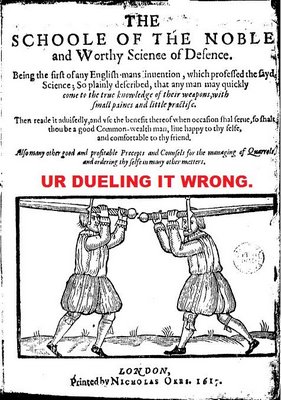
LOLManuscripts. Definitely in the guffaw class. Here are a couple of examples:

What a wonderful idea. Now the pedants amongst us will argue that these are not manuscripts, but I have no problem accepting the author’s “excuse”:

(P.S. I know they aren’t manuscripts…but LOL Early Modern Printed Materials didn’t have the same ring to it. LOLNomenclature! Let it go.)

I also loved the Shakespearian quote: [And yes, it’s accurate]

The large Achilles, on his press’d bed lolling, / From his deep chest laughs out a loud applause; / Cries ‘Excellent!'”

To me it’s a brilliant, if trivial, example of the sheer possibilities of modern digital culture, mashing LOLCats with old books. Something that remains possible despite the stupidities of modern intellectual property regimes. [I guess we’re not going to see LOLH***yP***er soon. Maybe someone should do it. We could all fall asleep reading the court records…..]

Update: I couldn’t resist adding these three illustrations, if they don’t tempt you into going there nothing else will:

Thank you Sarah Redmond. Fantastic stuff!

“They’ll find us”

We want people who are interested in books. They’ll find us.

So say Lloyd and Lenore Dickman, booksellers extraordinaire, Wisconsin, standing like Ruth amid the alien corn. Except for a couple of small details. Lloyd Dickman wouldn’t consider the corn to be alien, it is his love and his livelihood. And Lenore Dickman wouldn’t have a sad heart, she’s surrounded by things she loves. You see, they run an amazing bookshop. They don’t advertise. They don’t sell coffee. The books aren’t catalogued traditionally. And they’re housed in somewhat unusual surroundings, ranging from garden sheds to manure silos. Absolutely amazing story. Take a look at this video:

[Incidentally, I was reading Bibliophile Bullpen today, saw the link to the story, decided I would check it out later. Sometime soon after that I saw Euan Semple’s tweet (which referred to Tom Peters, or, more correctly, Cathy Mosca posting on the Tom Peters blog). Now I couldn’t resist, and I found myself at the same link, and this time stayed on and watched all the way through. Bibliophile Bullpen. Euan Semple. Tom Peters. Three blogs I read regularly. One way or the other I was destined to see this video today.]

I love books, read them voraciously, collect them obsessively. For quite a while I harboured ideas of running  a bookshop when I retire, a very simple bookshop. All books grouped into three classes: Over My Dead Body, books that you could see, even touch, but not take away; Make Me An Offer, books that you could actually buy, haggle with me about; and Take It Away Jose, books that you could just carry off in the cloth bags provided. No prices to be seen anywhere. A simple shop, but with a small condition. You had to prove you loved books before you came in. By answering one of five questions written on a blackboard outside. A passion rather than just a profession.

Then Google and mobile phones arrived, and that idea went out of the window. Now I still plan to have a library, at home and at the school I plan to build. The school that I shall retire to.

So. Given all that, you should not be surprised that I was entranced by what the Dickmans have done. There is so much that is remarkable about their story. How a husband and wife have managed to find a way to support each other’s passions. How they’ve built a model to integrate those passions into their daily lives. How they’ve done it while retaining their enthusiasm and their integrity.

Every time I hear stories about people like the Dickmans, it makes up for all the other stories that compete for my attention, stories designed to depress, to sadden, to shock and to corrupt.

So thank you Bill Geist, thank you CBS, thank you Bibliophile Bullpen, thank you Cathy Mosca, thank you Euan Semple.

And, most importantly, thank you Lloyd and Lenore. I shall make my pilgrimage one day. I don’t drink coffee anyway!

Two other things. There is something really important in the “they’ll find us” statement. The anti-advertising recommendation-driven very authenticity of what the Dickmans are doing, all implied in that statement. Something for all of us to think about in this strange world, a world where we’ve somehow managed to migrate the truly appalling business model of direct mail on to online search, a world where we think that’s a good thing….

The other thing is hidden away at the end of the Cathy Mosca post on Tom Peters’ blog:

Tom says if you’re not in love with this video please let us know, and we’ll take you off all our mailing lists

Again, something for us to mull over. How we’re moving to a world where traditional buyer-seller relationships are being replaced by cluetrain conversations between people who share important values.