Poplicola rides again: Berkman’s Publius Project

Publius Valerius Publicola, otherwise known as Poplicola, Roman counsel, ‘friend of the people’, had his name pseudonymously used to author the Federalist Papers,  a collection of essays written over two hundred years ago (primarily by Hamilton, Madison and Jay) to strengthen and ratify the US constitution.

Those must have been heady and challenging days, as a new country was born, as new citizens tried to figure out who they were and what they stood for.

For many of us, the internet is a modern parallel, as we strive to understand what it is, what it stands for, how it is inhabited, how it is governed. It is fitting therefore that the Berkman Center, as part of its 10th anniversary celebrations, has launched the Publius Project.

The project is described as “essays and conversations about constitutional moments on the Net collected by the Berkman Center.“, as people try and recapture the spirit of the Federalist papers.

I’m delighted and honoured to be part of that process, part of the project; the first few essays have now been published; do take a look, and let’s get the conversations going. Comments welcome.

Patently insane. And sad as well

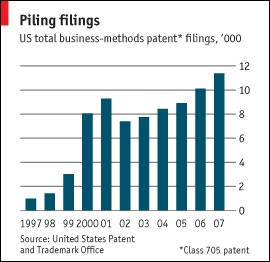
A recent article in the Economist highlighted the remarkable growth of Class 705 patents since they were made possible (see chart below, taken from that article):

While I am personally not a fan of such patents, I can understand why people would find them attractive, and why the number of patents sought in that class would mushroom. What really caught my notice was the passing reference to Josh Lerner’s work in this area:

Research by Josh Lerner of Harvard Business School found that patents on financial innovations were 27 times more likely than average to result in litigation. The defendants in these suits tend to be big investment banks and other financial institutions. Mr Lerner discovered that the most frequent plaintiffs in such lawsuits are patent-holding companies whose only line of business is the litigation of patent suits.

Now that is sad. “…the most frequent plaintiffs in such lawsuits are patent-holding companies whose only line of business is the litigation of patent suits“.

Thinking lazily about problem-solving methods

A little while ago I saw this somewhat unusual list of words:

It appeared on the xkcd blag, and Randall shared very little about it: It was in his handwriting, it looked faintly familiar, and he had no idea what it was about. You can see the whole story here.

I whiled away some time just thinking about how I would go about solving it.

That took me back a while, letting me reminisce about problem-solving techniques in general, how I learnt about them, what I found enjoyable about that learning.

For example, I still remember the first time I was presented with the “n” players in a knockout tournament, no ties, how many matches in the tournament question. n was set at 128; some people were doing the traditional 64+32+16+..+ thing, the rest of us had listened to the teacher. He very pointedly said “Think. How many losers?”. And we were ecstatic children, discovering for ourselves the truth that each match produced precisely one loser, and that the tournament needed 127 people to lose….

And so I thought to myself, of all the problems I’d seen where there was a lesson in problem-solving to be learnt, which one had I enjoyed the most?

I decided my personal winner was this one, presented to me in two parts:

(a) There is one, and only one, ten-term arithmetical progression of primes between 1 and 3000. Find it.

(b) Prove that no arithmetical progression of primes, containing eleven or more terms, can possibly exist between 1 and 20000.

I may have got the precise wording wrong, but the salient numbers are correct. See what you think. And if you have similar examples, where you learnt a simple problem-solving technique that stayed with you for the rest of your life, then please do share it.

[Incidentally, I still have no idea what Randall’s list is about. I used a progressive google search approach on the words (where you add one search term at a time and see how the top results behave) and the best I could come up with was “words at the top of successive pages in Animal Farm“. But it feels lame and unworthy. I quite liked one of the suggested answers, that the words were a sequence of captcha words. When I last looked not even Randall had figured it out.]

If you haven’t seen it yet…

…it’s worth checking out stackoverflow, and its associated blog.

A collaboration between Joel Spolsky and Jeff Atwood, both of whom I’ve followed for a while. I’ve listened to the podcasts, followed the blog posts, and so far I haven’t been disappointed. Worth the while. In fact I even like the logo.

Musing about Ebbsfleet….and Obama

….and Torquay.

Today’s headline: Ebbsfleet 1 Torquay 0.

And so Ebbsfleet win the FA Trophy.

Not bad for a club that was “taken over” by around 27,000 members, each of whom paid £35.

Here’s an extract from the Wikipedia article on the club:

On November 13, 2007, it was announced that the website MyFootballClub had entered a deal in principle to take over the club.[6] Approximately 27,000 MyFootballClub members each paid £35 to provide an approximate £700,000 takeover fund and all own an equal share in the club but make no profit nor receive a dividend. Members have a vote on transfers as well as player selection and all major decisions. Because of the nature of MyFootballClub, it was announced that manager Liam Daish would become instead the first team Head Coach. His backroom staff would remain at the club.[6]

Between January 16 and January 23 2008, MyFootballClub members were given the choice to vote on whether to proceed with the takeover and whether to allow Liam Daish to continue with his plans for the January transfer window. Both resulted in overwhelming “Yes” votes: 95.89% voted to proceed with the takeover while 95.86% voted to allow Daish to continue his transfer plans. The deal was ratified at an Extraordinary General Meeting of the club’s board on 19 February.

Collaborative ownership, collaborative management, championship trophies. Hmmm.

Now consider Barack Obama. The millions of dollars of campaign money generated by thousands of people paying small sums of money. What if his fans had the same power as Ebbsfleet fans (or, more correctly, MyFootballClub fans)?

Just thinking. Ebbsfleet is the shape of things to come. In more ways than one.